Welcome to Sector I-5! The majority of the sector is tropical and/or subtropical with major land masses, islands, and oceans. This looks like a very lush area, with plenty of opportunity for jungle and deep sea exploration. There are also some desert and hill areas on the southwest side of the largest land mass. There is bound to be something interesting in that area as well.
Our initial focus is on Hex 180.73. It is located on the southeast corner of the tear-shaped island to the center-right of the sector map. Most of this hex is a great ocean bay that was identified from orbit as a potential area suitable for coastal settlements and harbor construction.
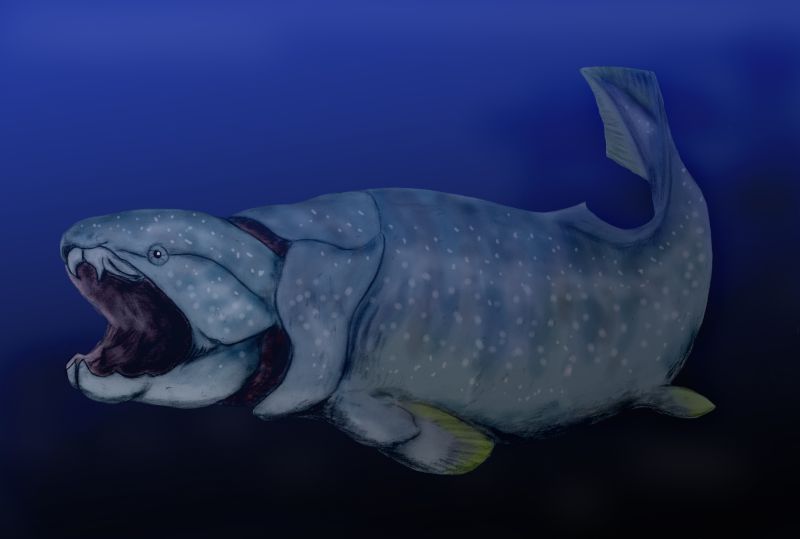
The bay has been dubbed New Manila Bay due to its oppressive humidity. It has abundant marine life including both armored fish (similar to Placodermi) as well as analogues of Earth’s more modern soft-bodied fish.
There are also numerous bioluminescent Cnidarians (jellyfish-like creatures) which surface and congregate several times per day. Their pulsating nocturnal displays are quite remarkable! The creatures also congregate in patterns that display mathematical progressions, which has been rather unsettling for observers.
Another distinctive feature of the bay – one which has been subsequently observed in other ocean areas – is the appearance of red scum on the ocean surface. This coloration is actually the chum created when pods of huge Rotorfish plough through schools of soft-bodied fish, slicing and dicing them before filter feeding on the blood and meat bits.
The soft bodied fish are also a potential food source. Analysis will reveal that if a few genes are altered, the fish will be an excellent source of nutrition for human settlers.
Humans are not the first intelligent species to explore the bay. Indeed, several large catamarans are hidden in one of the bay’s many lagoons. Diligent explorers will find them on the north shore of Hex 180.73.
Be sure to also check out FATEsf.blogspot.com for new and alternative information on Kepler 22-B.
*I hyphenate this because an I (i) looks so much like an l (L)
Sunday, July 29, 2012
Monday, July 23, 2012
What The?
Thursday, July 19, 2012
More from Sector C6
![]() |
| Image from wikipedia |
Mining Operation: A small band of prospectors has set up an illegal mining operation here, using heavy industrial disintegrators to plow up large swathes of the landscape to get to the veins of valuable ores (triskellium, lopadite and pseudo-silver deposits) below. The last batch of rains washed down from the hills and destroyed a portion of the camp and caused a flood in the lowlands. The sodden landscape is now crawling with bee-spiders, whose stings carry a rotting disease that has claimed many of the miners.
Landing Strip: The survey scouts have cleared this area to build a landing strip. The strip is too small for large, interplanetary craft, but is perfect for the light atmosphere freighters that deliver supplies from the Port Gernsback. A small caretaker's shack has been constructed from corrugated plaz-board and tin packing sheaths, and is lived in by Urgo Ezbik, an odd man who survived a zombie war but lost his left arm (he thinks it is still out there looking for him) and a small piece of his sanity. Still, he's a wiz with aircraft repairs. He has stocks of ammunition and food hidden throughout the area.
Olvugai Scout Survey: A team of olvugai are scouting this area in pogos on behalf of the Andromeda Confederation. They are mercenary scientists, but not particularly violent. One has been infected by alien bacteria (an oddity for olvugai) and they are at a loss to solve the problem, as their small supply of medicinal powders and tonics has proven ineffective.
Ancient City: The remains of an ancient city of the three-toed people sits here, choked by jungle and as-yet unexplored by spacers. The ruins hide large reservoirs of fresh water (much of it heavy), a large idol of golden-radium, subterranean laboratories, armories, treasure vaults and summoning chambers, and other wondrous things. Those who enter must beware the fungal growths that look like unicorn horns that will inevitably spring up on their unprotected skulls. The images of the three-toed people all show similar horns on their heads. They are, in fact, a form of fungal parasite/symbiote that did most of that species' heavy thinking and planning. They survive as an airborne fungus that clings to and then grows on sentient beings. There is a 1 in 6 chance per person they grow on that they will make meaningful contact and begin conquering their mind. Otherwise, they scramble a person's synapses and leave them a shuddering, incoherent mass on the forest floor.
Three bull zartodons have taken up residence here, sending out arcs of photovoltaic energy to attract females.
Wednesday, June 20, 2012
Every Alien Planet Needs a Good Logo ...
... and thanks to Judy and Jim Garrison at Hereticwerks, Kepler 22-B has one!
Says the artiste:
So, my sincerest thanks to Hereticwerks for the spiffy logo. If you are a contributor to the blog and want to use it, make sure you follow the rules. I don't want to have to sic Star Patrol on your sorry utt!
Says the artiste:
"We've been working a bit on our section of Kepler 22-B, and have created a graphic (a sample is attached) that we're using in our side-bar and in our posts to identify our Kepler 22-B/Strange New World posts. One of the other contributors to the Strange New World project has asked permission to use this graphic, so we thought that we'd contact you and offer to make this graphic available for use by the members of the project as a free resource. We have set up a Page at Hereticwerks that spells everything out fairly simply. The graphic is free to use, so long as we are given credit, it is not used commercially (without permission), and it is shared alike. A variety of sizes are available at the Photobucket folder in both JPEG and PNG format, and we can make things available in other sizes/formats if asked.
You can see the graphic in the right-hand side-bars at both Hereticwerks and Garrisonjames, and it will be in-use at John Till's SciFi-RPG blog currently under construction."
So, my sincerest thanks to Hereticwerks for the spiffy logo. If you are a contributor to the blog and want to use it, make sure you follow the rules. I don't want to have to sic Star Patrol on your sorry utt!
Friday, June 8, 2012
More Previews of C6
Alien Dinos: A herd of alien lifeforms that look like long-legged, soft shelled turtles, are grazing on the dark, spicy fruit of the tall umbrella trees that fill much of this hex. One of them has been tagged by some other survey team, and the group are wary around aliens (i.e. there is a 1 in 6 chance they will charge).
Androids: A band of the silver-faced androids from Crux 12 has set up shop here. They purport to be doing a scientific survey, but their equipment is outdated and mismatched, and they seem as though they are hiding something. In fact, they are religious cultists and worshipers of the Worm - a 22nd century computer virus that targets computer systems and artificial intelligences. They seek out computer systems and do their best to infect them.
Danglers: This hex holds one of the more unusual life forms on the planet. Strips of amino acids that look something like gossamer threads drape the Y-trees here. They are not dangerous, and when (or if) ingested in the proper sequence (this could be determined by a biologist with the proper equipment and a genius for creative thinking) put people into a waking trance that allows them to view, from a deep, biological perspective, the evolutionary history of the planet. There is always a chance, though, that the strings are poisonous to some aliens, and that they might play havoc with the DNA of others.
Tripods: The woodlands give ground to rolling plains of orange onion-grass and white feather-fronds. Amidst this natural beauty there are hundreds of alien monuments that look like tripods about 20 to 30 feet tall made of amethyst-colored glass. This glass substance is extremely durable, and actually behaves more like metal when damaged (i.e. it bends and dents, rather than shatter, but can be scratched). Each tripod has three legs (obviously) that join a ring. The interior of the ring carries a strange static charge. What this means is a mystery. (P.S. -Amethyst Tripod would be a great name for a band).
Canyon of Bones: A canyon here, with rugged walls (many hand and toe-holds and small, shallow burrows of the local petting-spiders) is filled with thousands upon thousands of bones. Most are animal in nature, but there are many humanoid bones mixed in as well, representing most of the intelligent species native to the planet. Kaiser-dogs burrow through the damp ground at the bottom of the canyon (it appears to have once been the bed of a small river) and the native bacteria seems to have given them a dim sentience of their own. Those who spend the time to dig deeper into the muck might find strange beings with large heads and small, bony bodies curved into a fetal position buried in the muck. These creatures appear to be carved from ivory, but are in fact a profoundly powerful species of psychics in suspended animation, awaiting the return of the river. Many of the locals regard them as sleeping gods, and make sacrifices to them (i.e. the bones).
Monday, May 7, 2012
Sector C6 Takes Shape ...
![]() |
| Source |
DOME OF THE PRESERVERS: Dwarfed by the soaring jungle canopy, one might discover a great Dome of the Preservers in this hex. The dome is constructed of a greenish metal of wholly alien origin, and, unlike many of the ruins to be found in the galaxy, this one is intact!
The dome is approximately one mile in diameter and about 300 feet high without an apparent means of entry. In fact, there are several access points on the exterior, all of them leading into the outer ring of the dome. One can open one of these access points by playing five musical notes (you know the five, and your players should be able to figure them out). Upon playing these notes, a door simply appears, the metal appearing to pull back almost like a curtain - at this point, scientists will note that the dome (exterior and interior) is composed of billions of tiny "granules" of green metal that react primarily to musical notes.
The outer ring of the dome is a passageway lit by a dim radiance that seems to just radiate from the walls, floor and ceiling. The same musical notes that gained one entry can be used to open passages into the inner ring, from which one can enter various chambers (offices, storage, etc.) of the alien Preservers, or call up from a subterranean storage tube thousands of alien animals from the past of Kepler 22B and many other planets. All of them are stored in force cages in temporal stasis, though various tunes can awaken and even release them (one must take care). The Referee should assign effects to the eight basic musical notes, both singly and in combination, allowing explorers to cause all sorts of havoc as they puzzle their way through them. The force cages literally rise from gaps that form in the green floor of the central hall of the dome. One can bring up 100 different cages at a time, creating a little zoo.
You can use the handy dandy alien animal generator in Space Princess to whip up the inhabitants of the force cages, as well as throw in a few famous beasts drawn from sci-fi literature. The Preservers also maintained a few sentient beings in temporal stasis, so a rare musical combination could bring one of these aliens up from the depths.
TRANSHUMANISTAS: The Transhumanistas are a motorcycle gang that roams the galaxy in search of rare components to help them leave their human shells behind, that they might ... oh hell, they're a bunch of nutty cyborgs who like to steal things and cause trouble. Fifty of them have set up camp here. They're scouting out the alien ruins and contemplating making a run on Galaxy Ranger post in the hills. The gang is led by The Black Daedalia, a woman who is now only 13.5% organic.
SLIME POTS: In this area, the thick jungle gives way to rocky plains dotted by tufts of tough, orange-green grass and something the explorers have termed "slime pots". The slime pots look something like the famous Indian paint pots of Yellowstone (a national park located on Earth in the United States of America), but they are filled with a shimmering, shivering ooze that is capable of spitting globules at creatures that approach too close (15 feet is usually a safe distance, but the pots have been known to spit up to 22 feet away). The slime globules burn the skin and cause their victims to hallucinate and lose their balance. They are gradually eaten away, hosting a new colony of slime, which begins constructing a new slime pot where its victim has fallen.
The entire area is crisscrossed by underground thermal vents, making the rocky ground warm and allowing various gasses to escape through cracks. These gasses have a tendency to inebriate humans and human-like aliens, making them easy targets for the slime pots.
An artificially intelligent communication satellite of the Jark Collective has recently fall into the area of the slime pots, and is waiting impatiently to be recovered and repaired.
BROWN BELLIES: The brown bellies are massive fungal domes that grow in the shade of the jungle. Each dome is a hemisphere measuring 1d4 + 6 feet in diameter. These domes play host to hives of alien wasps who operate on a higher mental plane than the average insect, using telepathic signals to link their miniscule minds into a single mind that is the equivalent of a 6 year old child with severe anger management issues.
VAMPIROIDS: A cruiser of the vampiroids was brought down on Keppler 22B some 500 years ago in a freak mishap. The ship's titanium superstructure has survived somewhat intact, though mostly buried, in the jungles here. The descendants of the vampiroids have survived as devolved, bat-like creatures with jutting fangs and a hankering for blood. They now dwell in the tree-tops in small cabals led by large, overbearing males. The females are capable of projecting illusions into people's minds, making themselves look like the seductive vampiroids of yore. Getting into the superstructure would present one with a treasure trove of vampiroid artifacts, and perhaps two or three members of the original crew in suspended animation.
Monday, April 23, 2012
Planet Building ... Silver Age DC-Style
Via HEROPRESS, a nifty map of Silver Age DC Krypton. Helluva place to adventure, wouldn't you say?
Who else would like to run a Krypton Science Police campaign on this map?
Subscribe to:
Posts (Atom)