Wednesday, June 20, 2012

Every Alien Planet Needs a Good Logo ...

... and thanks to Judy and Jim Garrison at Hereticwerks, Kepler 22-B has one!


Says the artiste:

"We've been working a bit on our section of Kepler 22-B, and have created a graphic (a sample is attached) that we're using in our side-bar and in our posts to identify our Kepler 22-B/Strange New World posts. One of the other contributors to the Strange New World project has asked permission to use this graphic, so we thought that we'd contact you and offer to make this graphic available for use by the members of the project as a free resource. We have set up a Page at Hereticwerks that spells everything out fairly simply. The graphic is free to use, so long as we are given credit, it is not used commercially (without permission), and it is shared alike. A variety of sizes are available at the Photobucket folder in both JPEG and PNG format, and we can make things available in other sizes/formats if asked.

You can see the graphic in the right-hand side-bars at both Hereticwerks and Garrisonjames, and it will be in-use at John Till's SciFi-RPG blog currently under construction."

So, my sincerest thanks to Hereticwerks for the spiffy logo. If you are a contributor to the blog and want to use it, make sure you follow the rules. I don't want to have to sic Star Patrol on your sorry utt!

Friday, June 8, 2012

More Previews of C6

Alien Dinos: A herd of alien lifeforms that look like long-legged, soft shelled turtles, are grazing on the dark, spicy fruit of the tall umbrella trees that fill much of this hex. One of them has been tagged by some other survey team, and the group are wary around aliens (i.e. there is a 1 in 6 chance they will charge).

Androids: A band of the silver-faced androids from Crux 12 has set up shop here. They purport to be doing a scientific survey, but their equipment is outdated and mismatched, and they seem as though they are hiding something. In fact, they are religious cultists and worshipers of the Worm - a 22nd century computer virus that targets computer systems and artificial intelligences. They seek out computer systems and do their best to infect them.

Danglers: This hex holds one of the more unusual life forms on the planet. Strips of amino acids that look something like gossamer threads drape the Y-trees here. They are not dangerous, and when (or if) ingested in the proper sequence (this could be determined by a biologist with the proper equipment and a genius for creative thinking) put people into a waking trance that allows them to view, from a deep, biological perspective, the evolutionary history of the planet. There is always a chance, though, that the strings are poisonous to some aliens, and that they might play havoc with the DNA of others.

Tripods: The woodlands give ground to rolling plains of orange onion-grass and white feather-fronds. Amidst this natural beauty there are hundreds of alien monuments that look like tripods about 20 to 30 feet tall made of amethyst-colored glass. This glass substance is extremely durable, and actually behaves more like metal when damaged (i.e. it bends and dents, rather than shatter, but can be scratched). Each tripod has three legs (obviously) that join a ring. The interior of the ring carries a strange static charge. What this means is a mystery. (P.S. -Amethyst Tripod would be a great name for a band).

Canyon of Bones: A canyon here, with rugged walls (many hand and toe-holds and small, shallow burrows of the local petting-spiders) is filled with thousands upon thousands of bones. Most are animal in nature, but there are many humanoid bones mixed in as well, representing most of the intelligent species native to the planet. Kaiser-dogs burrow through the damp ground at the bottom of the canyon (it appears to have once been the bed of a small river) and the native bacteria seems to have given them a dim sentience of their own. Those who spend the time to dig deeper into the muck might find strange beings with large heads and small, bony bodies curved into a fetal position buried in the muck. These creatures appear to be carved from ivory, but are in fact a profoundly powerful species of psychics in suspended animation, awaiting the return of the river. Many of the locals regard them as sleeping gods, and make sacrifices to them (i.e. the bones).

Monday, May 7, 2012

Sector C6 Takes Shape ...

Source
These previews are my own (and about damn time I wrote them) ...

DOME OF THE PRESERVERS: Dwarfed by the soaring jungle canopy, one might discover a great Dome of the Preservers in this hex. The dome is constructed of a greenish metal of wholly alien origin, and, unlike many of the ruins to be found in the galaxy, this one is intact!

The dome is approximately one mile in diameter and about 300 feet high without an apparent means of entry. In fact, there are several access points on the exterior, all of them leading into the outer ring of the dome. One can open one of these access points by playing five musical notes (you know the five, and your players should be able to figure them out). Upon playing these notes, a door simply appears, the metal appearing to pull back almost like a curtain - at this point, scientists will note that the dome (exterior and interior) is composed of billions of tiny "granules" of green metal that react primarily to musical notes.

The outer ring of the dome is a passageway lit by a dim radiance that seems to just radiate from the walls, floor and ceiling. The same musical notes that gained one entry can be used to open passages into the inner ring, from which one can enter various chambers (offices, storage, etc.) of the alien Preservers, or call up from a subterranean storage tube thousands of alien animals from the past of Kepler 22B and many other planets. All of them are stored in force cages in temporal stasis, though various tunes can awaken and even release them (one must take care). The Referee should assign effects to the eight basic musical notes, both singly and in combination, allowing explorers to cause all sorts of havoc as they puzzle their way through them. The force cages literally rise from gaps that form in the green floor of the central hall of the dome. One can bring up 100 different cages at a time, creating a little zoo.

You can use the handy dandy alien animal generator in Space Princess to whip up the inhabitants of the force cages, as well as throw in a few famous beasts drawn from sci-fi literature. The Preservers also maintained a few sentient beings in temporal stasis, so a rare musical combination could bring one of these aliens up from the depths.

TRANSHUMANISTAS: The Transhumanistas are a motorcycle gang that roams the galaxy in search of rare components to help them leave their human shells behind, that they might ... oh hell, they're a bunch of nutty cyborgs who like to steal things and cause trouble. Fifty of them have set up camp here. They're scouting out the alien ruins and contemplating making a run on Galaxy Ranger post in the hills. The gang is led by The Black Daedalia, a woman who is now only 13.5% organic.

SLIME POTS: In this area, the thick jungle gives way to rocky plains dotted by tufts of tough, orange-green grass and something the explorers have termed "slime pots". The slime pots look something like the famous Indian paint pots of Yellowstone (a national park located on Earth in the United States of America), but they are filled with a shimmering, shivering ooze that is capable of spitting globules at creatures that approach too close (15 feet is usually a safe distance, but the pots have been known to spit up to 22 feet away). The slime globules burn the skin and cause their victims to hallucinate and lose their balance. They are gradually eaten away, hosting a new colony of slime, which begins constructing a new slime pot where its victim has fallen.

The entire area is crisscrossed by underground thermal vents, making the rocky ground warm and allowing various gasses to escape through cracks. These gasses have a tendency to inebriate humans and human-like aliens, making them easy targets for the slime pots.

An artificially intelligent communication satellite of the Jark Collective has recently fall into the area of the  slime pots, and is waiting impatiently to be recovered and repaired.

BROWN BELLIES: The brown bellies are massive fungal domes that grow in the shade of the jungle. Each dome is a hemisphere measuring 1d4 + 6 feet in diameter. These domes play host to hives of alien wasps who operate on a higher mental plane than the average insect, using telepathic signals to link their miniscule minds into a single mind that is the equivalent of a 6 year old child with severe anger management issues.

VAMPIROIDS: A cruiser of the vampiroids was brought down on Keppler 22B some 500 years ago in a freak mishap. The ship's titanium superstructure has survived somewhat intact, though mostly buried, in the jungles here. The descendants of the vampiroids have survived as devolved, bat-like creatures with jutting fangs and a hankering for blood. They now dwell in the tree-tops in small cabals led by large, overbearing males. The females are capable of projecting illusions into people's minds, making themselves look like the seductive vampiroids of yore. Getting into the superstructure would present one with a treasure trove of vampiroid artifacts, and perhaps two or three members of the original crew in suspended animation.


Monday, April 23, 2012

Planet Building ... Silver Age DC-Style

Via HEROPRESS, a nifty map of Silver Age DC Krypton. Helluva place to adventure, wouldn't you say?


Who else would like to run a Krypton Science Police campaign on this map?

Friday, April 20, 2012

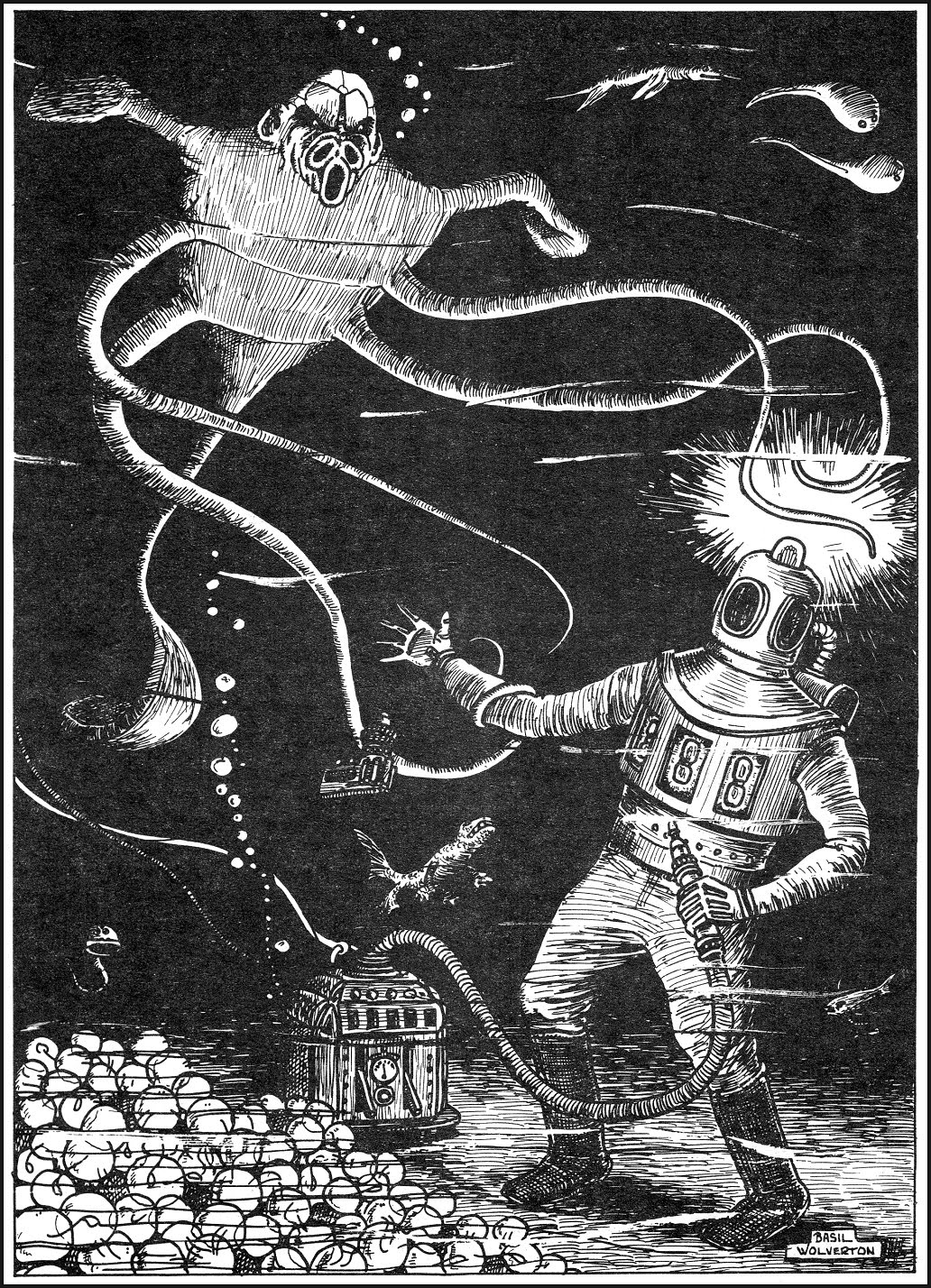
A Little Sci-Fi Inspiration from Basil Wolverton

Some classic image from the 1930's by Basil Wolverton, via Golden Age Comic Book Stories. Enjoy!

Are these things like a tourist's delight on this planet, or an actual menace?


As alien as our seas are, I can only imagine at actual alien seas.


Best part of this illo - the sci-fi utility shorts the aliens are wearing.

"I told you damn kids to play outside!"


I find myself drawn to 30's era spaceships more and more as I grow older. I have this weird feeling they got it right.


This and Leng were the prime inspirations for the plateau of Tsanjan in my Nod setting.


Saturn is proof that reality trumps imagination every time.

Thursday, April 19, 2012

Some More K22B Previews from Luke DeGraw

Note: These Doctor Who fish-people are not necessarily related to those in Hex 160.59
Well, stocking old K22B has been a little slow - I finally have some ideas generated for my own chunk of the planet, though several other projects are holding me up on completing them. In the meantime, enjoy some more previews from Luke DeGraw and Sector B8 ...

Hex 67.18
Many animal trails lead to this hex from all directions, merging as they become progressively closer to an epicenter. Animals of all kinds make their way to the center of the hex, where all the trails merge. Once there, they stand without moving for several hours before moving away. Sometimes, a multitude of animals will be present, ranging from snakes, spiders, and other small vermin to desert deer and large predators. They will push together, attempting to be as close to the center as possible. No animal attacks another. Animals in the center of a group will leave by pushing their way past the others and another animal will take it's place.

Should an animal be attacked by a player character, all animals currently caught in the trance will quickly turn their head (or their body, if they have no independant head) and gaze at the offender. Their eyes will immediately emit a glowing red light. The red light acts as an Intimidation effect against all who can see the light equal to the median HD/level of all animals present plus three, and it has a 100 ft. range. Should the offender cease attacking (by their own volition or intimidation), the animals will continue gazing for 2d6 seconds before the light dies out and they turn back to the epicenter. Should the offender continue attacking, all animals present will attack. If the offender moves 100 ft. from the epicenter, the animals will cease attacking and move back to the epicenter. However, if the offender moves back within 100 ft., the animals will immediately attack again.

Should the players dig ten feet down at the epicenter, they will find a disc mesuring two feet in diameter and three inches thick made of metal. It will have a red light in the center of one side. If pressed, the red light will turn off; another press will turn it back on. When on, it attracts animals from all over the sector, at an effective rate of 1d20 per day. If the device is turned off when an animal is present, it will immediately begin acting like a normal animal, i.e. run away, attack, etc. Predator animals are likely to attack other animals, if present, before attacking the player characters.


Hex 160.59
A peaceful village rests here on the shore of a mountain lake. It is populated with a race of fish-scaled humanoids who live both on land an in the water. They speak of a time when they had access to a water-without-end, but now they cannot leave the lake because they cannot survive the surrounding desert. The village is a trading post of sorts, though travelers are infrequent. There are commodities to be bartered for here, most importantly metal workers who shape metal using high-pressure water techniques. All metal items produced here are extra durable (double applicable durability), and bladed weapons are extra sharp (+1 damage).

The local people will tell of a water-stop at the bottom of the lake. If the players can find a way to get to the bottom of the lake, they will find a spring that has been gummed up with the barnacles of some kind of creatures. Straying too close, crab-like creatures will spill forth and attack the group. These crabs are about the size of a dinner plate and have razor-sharp pincers. Strength in numbers is their advantage, so individually they will not be difficult to kill. Once the crab threat is removed (by destruction, or other means), the barnacles can be broken away, releasing a full torrent of spring water. This will cause the lake to fill far more than it's current level and over the course of a few weeks it will spill over to create a new river. This river will flow south into Sector B9 and into the sea there. Randomly determine the direction the river takes in each new hex it enters, though it will always bear southerly. The fish-people will reward the players for their gracious feat.


Hex 12.65
A statue-fountain of a humanoid woman is at the top of this mountain. The fountain is in the shape of a woman kneeling before a basin. The water from the fountain trickles from the woman's eyes and into the basin. The stream of water does not break when falling off the woman's chin, creating a silent flow. Should the players drink from the fountain, they will feel greatly refreshed and focused, removing fatigue and giving them +1 to skill checks for four hours. The water can be bottled, and there is enough water in the basin to fill three normal sized water skins or flasks. The water in the basin refills in one hour. When bottled, the water will retain is unique properties for fourteen days.

The statue-fountain is actually a rendition of a mother-goddess who eternally weeps in joy and sadness for her children. If a player prays to or meditates on the goddess for one hour before the statue and then sleeps at its base during the night, the player will be visited by a dream of the goddess. In the dream, the goddess will reveal the presence of an ancient evil inside the bowels of the arcology to the east. Should the player be willing, the goddess will task him or her with destroying the evil and pledge her assistance. When the player wakes, a 1-inch cube will be in the player's pocket. When confronting the alien at the bottom of the arcology, the cube will strongly vibrate and emit a sound like a continuous bell chime. If presented before the alien, the runes will glow bright blue and the alien will be incapacitated and weakened for five rounds. During that time, the alien will not be able to move, attack, or defend, and all player attacks will automatically hit.

Friday, April 13, 2012

A World Where Dino's Evolved from Man?

Well, no. Not at all really, but you do need a snappy headline in this blog game.

Some scientists are throwing around the notion that intelligent life on other planets could be of the dinosaur persuasion. They don't really have any evidence, of course, but I think we can all agree that the rigors of scientific accuracy went out the window long ago for some members of the community (i.e. we need a freakin' grant - think of something cool).

Still, it's worth thinking about in terms of writing a sci-fi setting (which this blog is supposedly about). Humans, of course, have the brains, but we also have the thumbs, and that's pretty important if you're going to fashion lasers and rocket ships. On a planet of intelligent dinos, what if none of the dinos with intellect also got the digits to put it to especially good use. They can think and philosophize, but they don't have the tools to dig deeper into the mysteries of the cosmos. Meanwhile, some other branch of the family got the thumbs, but not the sense to use them. So, when planning your sector of Keppler-22B, please give some consideration to super-genius saurpods or just good old fashioned intelligent raptors, won't you.

GIF found at HATE:WRECK:PERIL, along with these dandies ...

These are the Transhumanistas, a biker gang of cybernetic women who roams my sector of K22B

This is the greatest movie ever made (yes, better than Citizen Kane)

These are the silver faced androids of Crux-12, preaching their gospel in my sector of K22B

Related Posts Plugin for WordPress, Blogger...